Nociception vs. Pain: Not the Same Signal
Specialized nerve endings called nociceptors detect potentially harmful stimulation — pressure, heat, or chemical irritation — and send that signal up through the spinal cord toward the brain. From there, the signal reaches the thalamus, which acts like a relay station, and then spreads out to several brain regions at once: areas that map where and how intense the sensation is, and areas that add emotional weight and meaning.
That distinction matters: nociception is the raw signal. Pain is what the brain constructs once it weighs that signal against emotion, memory, and context — related, but not the same thing.
A Multidimensional Experience
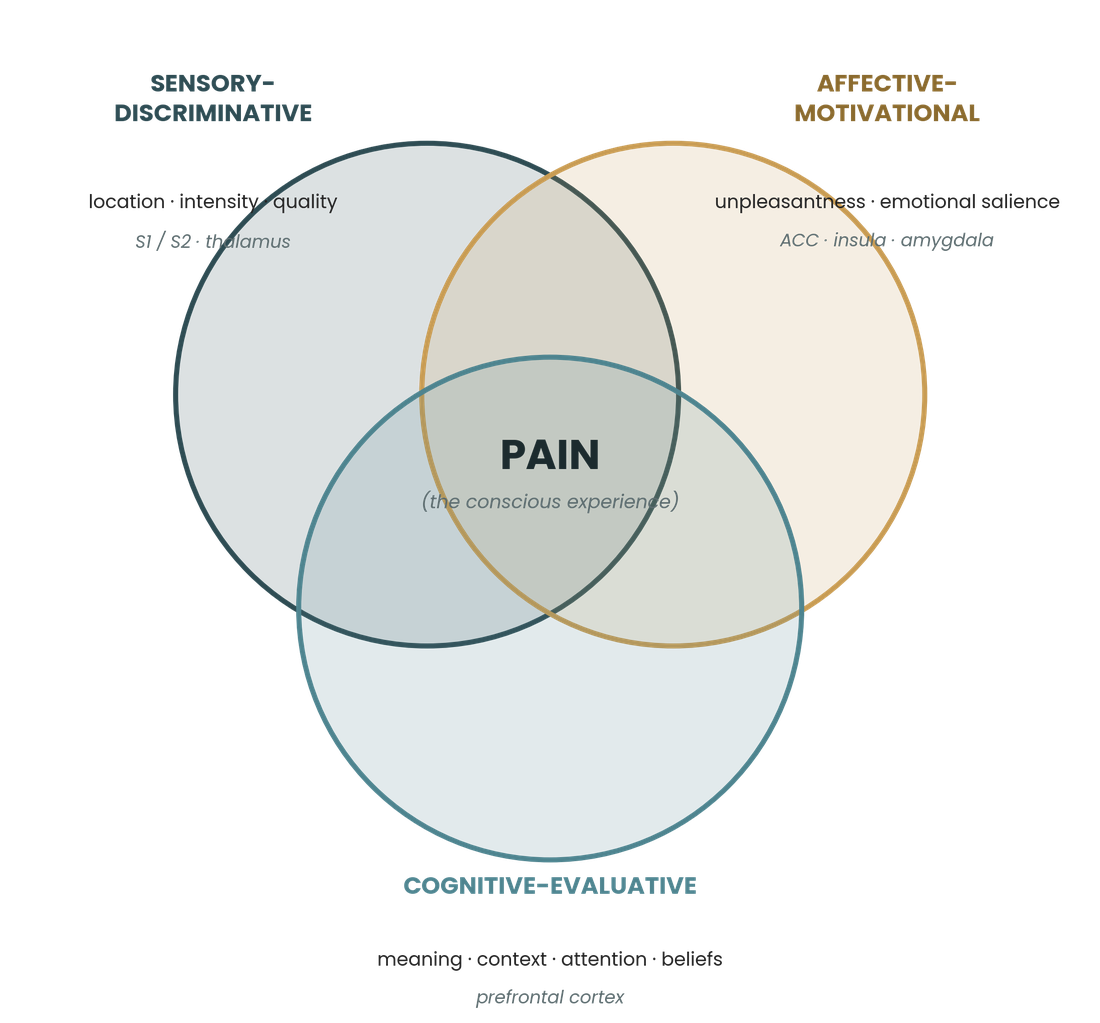
A well-established model in pain science describes pain as the product of three interacting dimensions, processed across a network of brain regions working together — not a signal from any single “pain center.”
Two people with identical scans or tissue findings can have very different pain experiences, because each dimension — and each person's history and biology — differs.
Central Sensitization: A Nervous System That Amplifies
When pain signals keep firing over time, the spinal cord and brain can become more efficient at sending and amplifying them — similar to how a path gets worn into grass from repeated walking. Nerve connections strengthen, and support cells in the nervous system (called glial cells) become more active, turning up the signal even further.
The result is a nervous system that responds more strongly to pain (hyperalgesia) or starts reacting to input that normally wouldn't hurt at all, like light touch (allodynia) — a change in processing, not necessarily a sign of worsening tissue injury.
Descending Modulation: The Brain Talks Back
The brain doesn't just receive pain signals — it also sends signals back down to the spinal cord that turn the volume up or down before the message even fully registers:
Turning it down — brain chemicals like serotonin, noradrenaline, and the body's own natural opioids can dampen incoming pain signals.
Turning it up — under chronic stress, poor sleep, or an already-sensitized nervous system, that same system can amplify pain signals instead.
This two-way system is a major reason mood, stress, sleep, and expectation measurably change how much pain someone feels from the exact same physical input.
Why a Biopsychosocial Model Is Necessary
Because pain emerges from a distributed neural network rather than a single pathway, durable change typically means addressing multiple systems at once:
Biological — tissue health, movement, sleep, systemic inflammation
Psychological — beliefs about pain, fear-avoidance, mood, self-efficacy
Social — relationships, work demands, access to care, cultural context
This is why pain neuroscience education is most effective when paired with active, graded movement — not delivered as information alone.
Putting It Into Practice: Four Pillars
A well-rounded pain recovery program addresses all four of these together — not just the painful area in isolation.
01 SLEEP
Poor sleep lowers pain thresholds and tilts the brain's descending pathways toward amplifying pain instead of dampening it.
02 MOVEMENT
Graded, progressive movement retrains a protective nervous system and rebuilds strength, tolerance, and confidence.
03 PAIN NEUROSCIENCE EDUCATION
Understanding how pain works reduces fear and catastrophizing — most effective paired with the other three pillars.
04 GOAL SETTING
Specific, meaningful, graded goals give the nervous system a clear target and make progress measurable beyond pain alone.
Pain is complex, but progress is possible — real change is usually built one small, steady step at a time.